
senior figures mapped
senior roles tracked
Financial Services firms
documented role moves
Everyone in the sector agrees that cyber, fraud and financial crime are converging. Far fewer agree on what that convergence actually looks like in a leadership team — and our mapping suggests no single model has yet settled. Given how quickly the threat evolves, and the breadth of capability now required to counter it, that is perhaps unsurprising. Convergence is real, but its intensity varies sharply by sector, and where it is happening hardest, it is fragmenting into several genuinely different shapes of leader. For anyone hiring at MD/ED level, the headline is not that convergence is coming. It is that “financial crime leadership” now means materially different things depending on where you sit. And because the shape of the role differs so sharply by model, so does the capability it demands and the talent pool it can be drawn from; the leader who fits one model is rarely interchangeable with the leader who fits another.
The clearest pattern in the data is that convergence intensity follows the presence of a fraud-and-cyber nexus, not the presence of AML obligations. It is maximal in banks and payments, where authorised-push-payment fraud, account takeover, mule networks and real-time payments force fraud, AML, sanctions and cyber-threat into the same operational space. It is emerging in insurance, where counter-fraud and financial crime are beginning to combine but remain roughly twelve to twenty-four months behind banking. And it is largely absent in asset management, where there is no consumer or claims fraud to converge with at all.
That progression matters because it reframes the driver. If convergence were an AML phenomenon it would appear evenly across regulated firms, since all of them carry AML obligations. It does not. It clusters precisely where fraud and cyber collide — which tells us the convergence story is fundamentally a fraud-and-cyber story, and lets us predict where converged leadership roles will appear next rather than merely describing where they are now.
Convergence is being forced to the surface by developments with firm dates on them. At the ecosystem level, fraud and cyber crime are now being fused in shared infrastructure — the Online Crime Centre, launched in April 2026 with the National Crime Agency, GCHQ and the National Cyber Security Centre alongside banks and telecoms firms, and the NCA’s Data Fusion partnership, which pools transaction data from eight banks with law-enforcement intelligence under the National Economic Crime Centre. At the regulatory level, the failure-to-prevent-fraud offence, in force since September 2025, puts fraud prevention on the same strict-liability, board-accountable footing as bribery and tax evasion — pushing fraud up the organisation and into the same governance conversation as the rest of economic crime.
Inside firms, the organisational response has been forming for several years and is now clearly legible: a single senior function pulling fraud — historically a separate, first-line operational discipline — into the same leadership remit as AML and sanctions. The larger banks have led it. One Tier-1 bank runs the function as Group Economic Crime Prevention; another has built an MD-level Integrated Financial Crime function. The language — “economic crime,” “integrated financial crime,” rather than the older, narrower “financial crime compliance” — is itself the signal: this is convergence made concrete, not a slogan but a reporting line.
Inside banking and payments — the sector where the fraud-and-cyber convergence is most advanced — it is not producing one model. It sorts along two axes. Scale determines whether a firm integrates or compresses: large institutions build multi-pillar teams in which fraud, financial crime and the cyber-threat capability sit under coordinated senior ownership, while sub-scale firms collapse the whole remit — fraud, AML, sanctions and, increasingly, cyber-enabled crime — into a single combined seat. Heritage determines where the function sits and who runs it: traditional banks treat it as a second-line risk-and-compliance discipline, while digital-natives, for whom fraud and cyber are native product-and-data problems, treat it as a product-and-engineering one.
Cross those axes and three live operating models emerge, each implying a fundamentally different hire: the integrated model of the large traditional banks; the compressed single-leader model of the sub-scale firms; and the build-native model of the scaled fintechs, where fraud, cyber and financial-crime controls are engineered into the platform rather than bolted on as oversight — the model in which convergence is least an aspiration and most simply how the system was built. A firm choosing between these is not choosing a style; it is choosing a different candidate pool entirely.
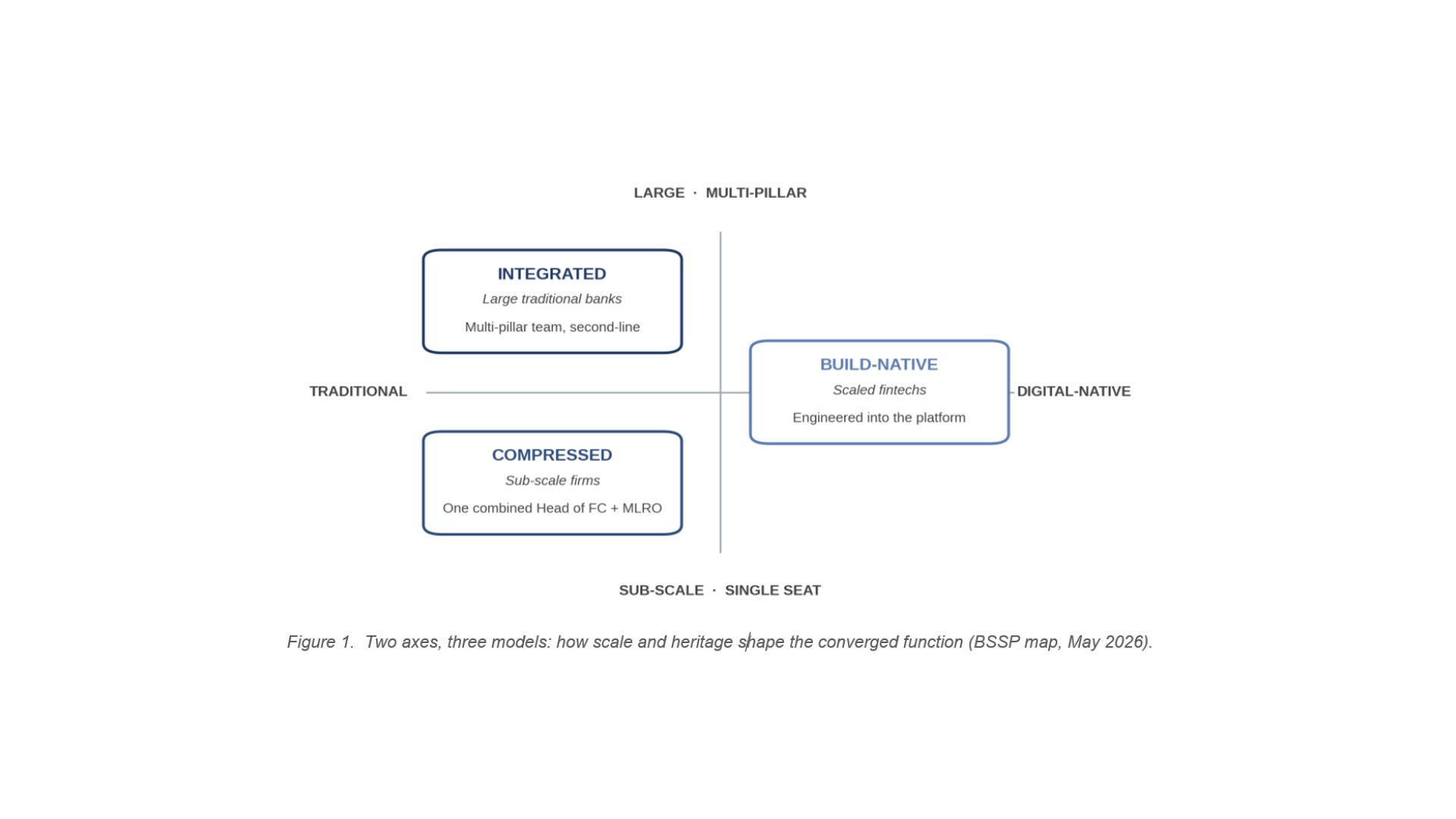
At the largest banks, the defining feature is structural depth. Rather than a single head of financial crime, these institutions now field multi-pillar leadership teams — separate senior owners for group strategy, first-line controls, threat and intelligence, analytics, and the statutory money-laundering reporting function, often reporting along parallel lines into both Group Risk and Compliance. Each of the UK’s largest banks now runs a version of this architecture; the single-leader financial-crime function is, at this tier, already an anachronism.
One sub-structure recurs with enough consistency to be predictive: a dedicated threat and intelligence seat, typically filled by a senior leader drawn from law enforcement or national security. At one Tier-1 bank that seat is held by a former senior UK law-enforcement leader in economic and cyber crime. The model has a traceable lineage — it was pioneered at a global bank, where a former senior US financial-intelligence official leads financial-crime threat mitigation globally and a former US federal prosecutor runs it across the European entities. Where the threat seat sits, and the kind of leader it attracts, is now consistent enough across the top tier to brief a search against.
At the other end of the scale, the picture inverts. Mid-tier banks, building societies, specialist lenders and smaller fintechs overwhelmingly run a single combined leader — typically titled along the lines of “Head of Financial Crime and MLRO,” frequently absorbing compliance and occasionally even data protection into the same role. One person carries fraud, AML, sanctions and the statutory reporting obligation. This is the compression model, and it appears with striking consistency across firms that otherwise have little in common — confirming that compression is driven by scale, not by segment or heritage.
The sharper, less obvious point is what is happening to those compressed seats. The current wave of UK FS consolidation — a building society’s acquisition of a challenger bank, and the integration of a direct motor insurer into a composite insurer — is actively eliminating compressed leadership at the absorbed firms rather than creating new seats. The acquirers differ, a building society and a composite insurer, but the consequence at each target is the same: a combined Head of Financial Crime + MLRO seat seemingly oversubscribed in the merged entity, and a potential source of senior financial-crime talent — a dynamic worth understanding for anyone building a pipeline. Add a Tier-1 bank’s acquisition of a mid-tier high-street bank to the mix and the pool widens again: that deal sits in the multi-pillar tier rather than the compressed one, but the absorption has swelled the acquirer’s UK financial-crime operating number and frees senior talent the same way.
The earliest read on the next phase is individual roles changing shape, ahead of any settled model. Insurance is the clearest: claims counter-fraud, historically a large, separate operational function divorced from the AML team, is beginning to combine with financial crime. At one insurer a director of counter-fraud and financial crime now holds exactly that paired remit, and another, this one FTSE 100-listed, has consolidated financial crime, fraud and third-party risk under a single director — insurance moving onto the same curve banking is already well along, roughly twelve to twenty-four months behind.
Three further signals point the same way.
is spreading downward from the top tier into business banking and the mid-tier, carrying fraud and AML into a single remit as it goes.
are also spawning their own converged economic-crime-prevention roles — spanning AML, sanctions and fraud alongside product and engineering — the build-native pattern reaching the regulated banks.
and AML converge in the data and analytics layer where those signals are fused, the specialists who build the detection models are beginning to cross into the leadership line that owns them: one recent move to MD, Head of Financial Crime at a global bank, from a financial-crime modelling background, is among the clearest.
Meanwhile the most senior live mandates continue to cluster at the top tier of banking and the scaled fintechs, while the sub-scale tier sheds seats through consolidation. The institutions building the deepest converged functions are also the ones hiring into them; the question for the rest of the market is no longer whether to follow, but when, and into which model.
A closing note. The operating-model choice — integrate, compress, or build native — increasingly determines the hire before any individual is considered. Getting the model right is the first decision; getting the person right is the second. The two are routinely conflated, and the cost of conflating them is usually discovered eighteen months in.
Method. This commentary draws on BSSP’s proprietary leadership map covering 124 senior seats across six UK FS segments, focusing on movement over roughly the last eighteen months. Aggregate patterns are reported as patterns; named individuals and firms are omitted from this public version.
Brown Strategic Search Partners is a boutique senior executive search firm focused on data, AI, governance and senior risk mandates at MD and ED level in UK financial services. The mapping behind this work is a working asset we maintain continuously and use to advise on senior seat design, candidate selection, and architectural decisions. We welcome a conversation on any of these findings or a specific senior question on your bench.
Insight-first: Every mandate begins with a structured view of the market, capability trends and leadership patterns.
Integrated lens: We surface cross-domain leaders who operate across technology, data, regulation and strategy.
Pricing philosophy: A flat-fee structure shaped by in-house executive hiring experience — typically 40–60% below traditional search pricing — designed for clarity, predictability and senior delivery.
Senior appointments across Governance, Data & Transformation with specialist FS firms — banks, payments providers, insurers, fintechs and regulated infrastructure.
Example hires:
Governance – Director of Compliance & NF Risk · Head of Operational Risk for Tech, Cyber & Data · Chief Risk Officer, Channel Islands · Head of Financial Crime, Corporate Bank
Data & Emerging Technology – Head of AI Strategy · Head of AI Data Engineering · Head of Data Governance · Chief Architect